Codayak — The AI Coding Workbench for Windows
The AI coding workbench that writes code, builds it, tests it — and proves it works before you release it.
Signed installer · Windows 10/11 · run as administrator
The AI coding workbench that writes code, builds it, tests it — and proves it works before you release it.
Signed installer · Windows 10/11 · run as administrator
Codayak is a free AI coding workbench for Windows 10 and 11, made by Techniche Labs Pty Ltd in Queensland, Australia. It is a standalone desktop application that sits beside your editor: point it at a repository and it reads, writes, builds, tests and verifies your code through the LLM provider you choose, on your own API key. What sets it apart is the Trust Engine — it builds, tests, security-scans and spec-checks its own output and reports a confidence-scored trust band, so you know what it actually did before you rely on it. Free for personal and commercial use; not open source.
Codayak — Code Orchestration & Development Assistant: Your Automation Kit
Ask for a change; Codayak writes it, builds it, tests it — and shows you the evidence before you rely on it.
A full source-code map — every project, type, member and dependency edge — plus dependency-aware retrieval that pulls coherent slices for cross-cutting work.
Surgical find/replace, line-range and between-marker edits. Every write is backed up first and shown in a side-by-side diff.
Builds, runs tests, runs the app, scaffolds test projects and drives the dotnet CLI — so it fixes what it broke instead of handing you a guess.
Executes against SQL Server, PostgreSQL, MySQL/MariaDB, SQLite or Oracle to query, inspect and test the database code it just wrote.
Opens actual Chrome, snapshots the page, clicks and types through the flow to verify the UI it changed.
Attaches to a desktop app via UI Automation and exercises the controls it just built.
Line-by-line review on Azure DevOps and GitHub under your team's rules — comment-only unless you explicitly ask it to vote.
The Trust Engine builds, tests, security-scans and spec-checks the output, then reports a confidence score with per-checker evidence.
Distils durable lessons into a local memory and surfaces the relevant one before you hit the same wall twice.
Hand it a project to scaffold and it plans the file manifest, generates every file in dependency order across parallel worker sessions and retries failures — optionally verifying each phase, and resuming where it left off if you stop.
Four image providers with reference-image editing, text-to-video, video analysis, and text-to-speech and speech-to-text across five speech providers.
Fans one question across up to ten worker LLMs with different analytical framings, then hands every perspective back to be judged.
Anthropic, OpenAI, xAI, Google, MiniMax, Moonshot and Zhipu — connected directly on your own API keys, switchable mid-conversation.
Several Codayak instances on your LAN collaborate on one goal over an encrypted link — planner, coders, reviewer — each on its own model.
Manages the context window so long sessions don't run dry, and picks up a conversation days later without re-explaining.
Your message goes to the model you chose; the model calls tools that run on your machine; the Trust Engine checks the result; the verdict and the diff come back to you.
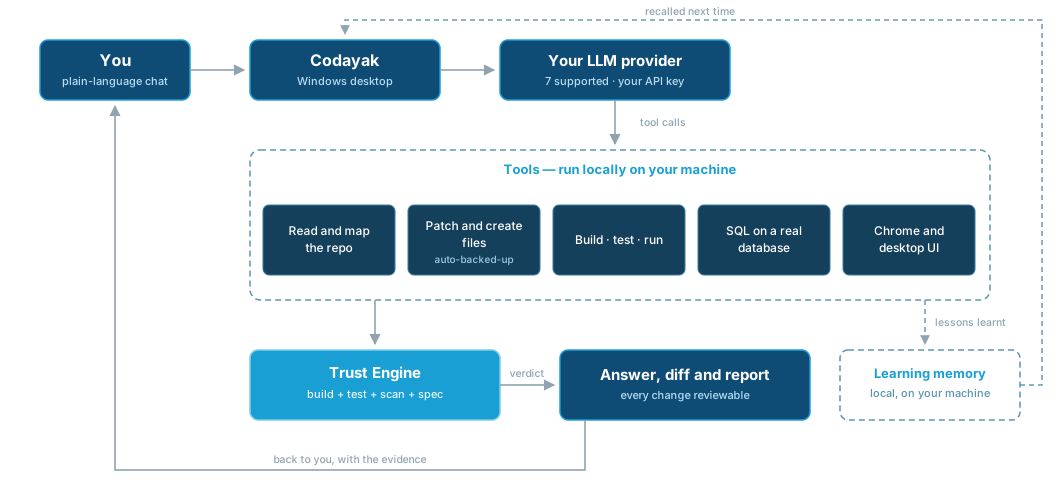
Plain-language chat in the Codayak desktop app.
Seven supported, called directly on your own API key.
Map the repo, patch files, build, test, query the database, drive the UI.
Build, test, security scan and spec-compliance check on the result.
The answer, the diff and a confidence-scored report — with lessons stored for next time.
Most assistants generate plausible code and hand it over. Codayak can build it, test it, scan it and spec-check it, then give you a trust band and the evidence behind it.
Lessons from what broke and what fixed it are stored locally and surfaced on future turns — you explain a convention once, not every session.
A tiered repo map plus dependency-aware retrieval means it changes a thing consistently everywhere, not just in the file in front of it.
Auto-backup before every write, a side-by-side diff, and one-command rollback. The Write to Repo switch is off until you turn it on.
Codayak instances on your LAN can form a leader/specialist team — the leader plans the work, farms tasks out to peers running their own models, and reviews the results. Each peer can run a different LLM — leader on Anthropic, specialists on OpenAI, Google or xAI — so one team can mix providers on a single task. Encrypted peer-to-peer, no cloud relay.
It doesn't stop at writing code — it compiles with MSBuild, runs your test suite, executes SQL against your database, and clicks through your web or desktop UI to test it. It even files the PR review comments in Azure DevOps or GitHub.
Yes. Codayak is free for personal and commercial use under a proprietary freeware licence. There is no trial, no seat limit and no paid tier. You pay your LLM provider directly for the tokens you use. It is not open source.
Codayak is a native Windows desktop application for 64-bit Windows 10 (1809 or later) and Windows 11. It requires the .NET 8 Desktop Runtime and Microsoft Edge WebView2; the installer checks for both. There is no Mac or Linux version.
Seven providers, connected directly on your own API keys: Anthropic, OpenAI, xAI, Google, MiniMax, Moonshot and Zhipu. You can switch model — or provider — in the middle of a conversation without losing it. Codayak is not a reseller: nobody sits between you and your provider. A "Fetch Latest" button pulls each provider's current model list, so new models are usable as soon as they ship.
Yes. Codayak reads .sln and .csproj structure, builds with MSBuild or the dotnet CLI (including legacy ASP.NET projects that need full MSBuild), runs your tests with dotnet test, scaffolds xUnit/NUnit/MSTest projects and runs your app. It works alongside Visual Studio rather than replacing it — it is not an editor.
The Trust Engine runs after generation: it builds the code, runs the tests, performs a security scan and, when you supply a specification, checks that every required feature is present and wired up. It then reports a trust band (High / Moderate / Low), a confidence score, per-checker evidence and recommendations. Every report is saved to the repository's .coda/verification/ folder as an audit trail.
Yes. It runs dotnet test and reads the results, and it executes SQL against SQL Server, PostgreSQL, MySQL/MariaDB, SQLite and Oracle to query data, inspect schema or test the database code it just wrote. Database writes are gated behind the same Write to Repo switch as file writes, and Codayak asks before touching a database on its own initiative.
Yes — two ways. It opens a real Chrome browser, snapshots the page's interactive elements, clicks and types through a flow and waits for results. For Windows desktop applications (WPF, WinForms, Win32) it attaches via UI Automation and exercises the controls. Credentials pass as placeholders and are never typed in plain text.
No. Codayak runs on your machine with no account and no server. Your code, prompts and keys go only to the LLM provider you configured. Learning memory is embedded on-device and stored in a local SQLite file. The only thing Codayak itself sends is a once-a-day update check carrying a random install identifier and the version number.
Not until you turn on the Write to Repo switch, which is off by default. When it is on, every write is backed up first to .coda/backups/, shown in a side-by-side diff, and can be rolled back with one command. Reference repositories, directories and wikis you attach are read-only by construction.
Cursor and Windsurf are editors (VS Code forks); Copilot is an editor extension; Claude Code is a terminal tool. Codayak is a standalone Windows workbench that sits beside your editor. The practical differences are that it verifies its own output with a confidence-scored report, runs real SQL and drives real browser and desktop UIs to test what it built, reviews pull requests under your team's rules, and lets you use seven providers on your own keys with no intermediary.
Several Codayak instances — on one machine or across your LAN — form an encrypted leader/specialist team. The leader plans the work, delegates tasks to peers (each running its own model and provider), and reviews the results. Peers can hold different repositories, so one team can work on an app and the API it depends on at the same time. Traffic is end-to-end encrypted (Ed25519 identity, X25519 key exchange, AES-256-GCM, TLS with certificate pinning) with no cloud relay.
The installer and application are digitally signed by TECHNICHE LABS PTY. LTD. with an Extended Validation certificate. Windows may still show a SmartScreen notice until the new certificate earns reputation from download volume; click "More info" → "Run anyway". The SHA-256 hash of each installer is published on the GitHub release page so you can verify the file.
Free for personal and commercial use. Windows 10/11 (64-bit).
⇩ Download Codayak for WindowsSigned by Techniche Labs Pty Ltd (EV certificate). Run the installer as administrator. Windows may show a SmartScreen notice until the new certificate earns reputation — choose "More info" → "Run anyway". SHA-256 hashes are on the GitHub release page.
View releases and release notes on GitHub
By installing or using Codayak you accept the End User Licence Agreement shown during installation (free for personal and commercial use; provided as-is; no redistribution or modification). Requires the .NET 8 Desktop Runtime and Microsoft Edge WebView2 — the installer checks for both and points you to Microsoft's free downloads if needed.
Live figures. Downloads are independently verifiable on GitHub.
Free for personal and commercial use. You may not redistribute, modify or reverse-engineer it. Provided "as is", with no warranty. The full End User Licence Agreement is shown during installation and inside the application at any time.
Want priority support, procurement paperwork, or a hand rolling Codayak out to your team? Contact us — we're a software house, and we're happy to talk.